How to Protect Your Team from Paint Fumes on Industrial Sites
Paint fumes are often an unavoidable part of industrial work, from fabrication and manufacturing through to maintenance and repair. However, what is often treated as a routine part of the job can expose workers to harmful airborne chemicals if it is not properly controlled.
In enclosed or poorly ventilated environments, these fumes can build up quickly, creating conditions where exposure levels may exceed safe limits without being immediately obvious.
Protecting workers from exposure is not optional. It is a legal requirement under UK health and safety legislation, and it plays a critical role in maintaining safe, compliant and productive workplaces.
Why Paint Fumes are a Serious Workplace Hazard
Paint fumes are particularly hazardous in industrial settings because exposure is not always obvious at the point it occurs.
Unlike dust or visible contaminants, solvent vapours and chemical emissions can be:
- Invisible in the air
- Present without strong odour in some cases
- Able to spread quickly through enclosed spaces
This makes it difficult to identify risk in real time, meaning exposure may occur before control measures are reviewed or adjusted.
The risk is most significant in environments where fumes are more likely to accumulate. This includes indoor spray or coating operations, poorly ventilated work areas or settings where multiple processes are taking place at the same time.
What is in Paint Fumes?
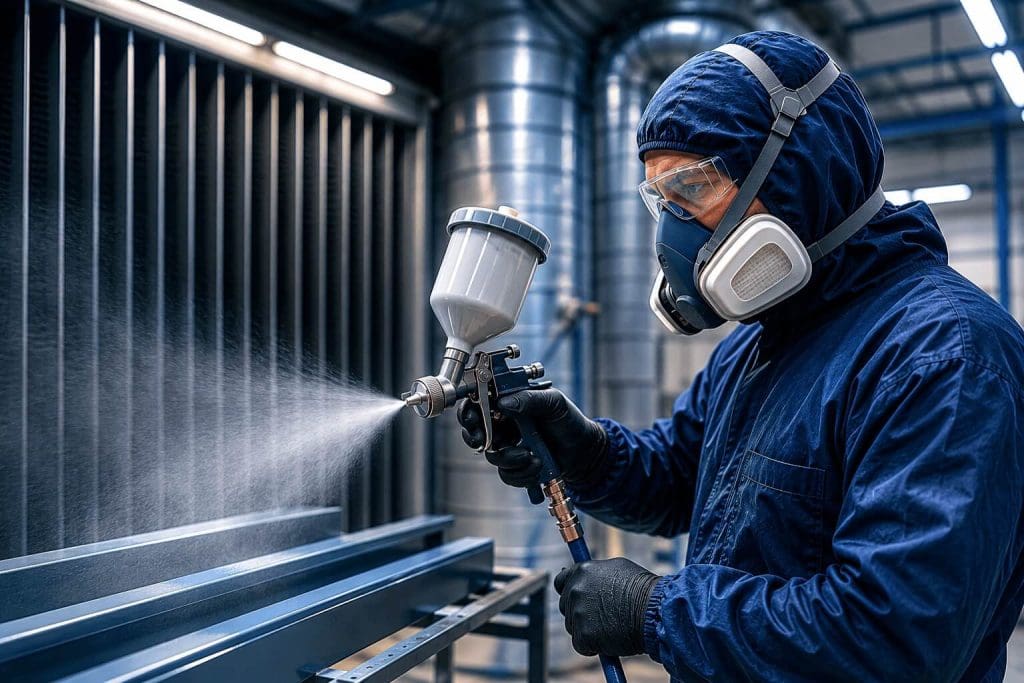
Paint fumes are not a single substance but a mixture of airborne chemicals and fine particles released during application, drying and curing.
Depending on the product being used, this may include volatile organic compounds (VOCs) released from solvent based paints, aerosolised particles generated during spray application, and additives such as thinners, hardeners and binders.
The exact composition and concentration will vary depending on the coating system and application method, but in industrial environments these substances can still accumulate quickly, particularly during repeated or large-scale coating tasks.
Workplace Exposure Limits and Employer Responsibilities
Exposure to paint fumes can cause both short term and long term health effects if controls are not sufficient. In the short term, workers may experience symptoms such as headaches, dizziness, eye and throat irritation, nausea and reduced concentration. With repeated or prolonged exposure, there is a greater risk of respiratory issues and potential effects on the nervous system and internal organs.
The HSE publishes legally binding Workplace Exposure Limits (WELs) for hazardous substances through EH40, which sets the maximum concentration of airborne substances that workers should be exposed to over a specified time period. These limits apply to many of the chemicals commonly found in paints and coatings, including individual solvents and VOCs. Employers are required to ensure that exposure does not exceed these limits and, where possible, to reduce exposure to as low a level as is reasonably practicable. WELs should be used as part of the overall risk assessment process to determine whether existing control measures are adequate and whether additional extraction is required.
For this reason, employers are required to ensure exposure is either prevented or adequately controlled. In practice, this means:
- Identifying substances used in coating and painting processes
- Assessing the level of exposure risk in the specific working environment
- Implementing effective control measures to keep exposure as low as reasonably practicable
- Maintaining and regularly testing any control systems in place
- Providing workers with suitable information, instruction and training
Relying on general ventilation alone is rarely sufficient in industrial environments where solvent based coatings are used or where painting is carried out in enclosed spaces. Effective control usually requires a combination of engineering solutions, safe working practices and where necessary, personal protective equipment.
When Extraction is Required
Extraction should be considered essential whenever paint fumes cannot be adequately controlled through general ventilation alone. In many industrial environments, particularly those involving solvent based coatings, relying on air movement within the building is not enough to prevent the build up of airborne contaminants.
This is especially important in situations such as:
- Indoor spray painting or coating operations
- Work carried out in enclosed or partially enclosed spaces
- Tasks involving continuous or high-volume application
- Work areas where fumes are noticeable or linger in the air
- Environments where multiple coating processes take place simultaneously
In these conditions, fumes can accumulate at source and spread throughout the workspace, increasing the likelihood of worker exposure above safe levels.
Localised control at the point of emission is therefore often required to effectively manage risk and maintain a safe working environment.
What Extraction Equipment is Appropriate for Paint Fumes?
Once extraction is required, the most suitable solution will depend on the working environment, the nature of the task and the level of risk involved.
In industrial environments where painting and coating tasks are carried out regularly, The SA CYCLONE Vapour Extraction System is a fully EX compliant, modular and portable extraction solution designed specifically for painting and coating operations in these conditions. With a fully bonded and antistatic system design, it is engineered for use in environments where ignition risk control is essential.
The system provides high-capacity vapour removal, filtering contaminated air through a three stage process before expelling clean air back into the workspace. This is particularly relevant where on-site conditions, temporary setups or EX compliance requirements make conventional LEV arrangements less practical.
Best Practice for Controlling Paint Fumes
Extraction systems are most effective when used as part of a wider control strategy. Employers should also consider:
- Regular inspection and maintenance
- Training workers on correct use of equipment
- Using lower VOC or water based coatings where possible
- Ensuring appropriate general ventilation is in place
- Providing suitable respiratory protective equipment where required
A combination of controls helps ensure exposure is consistently managed rather than relying on a single solution.
Protecting Workers from Paint Fume Exposure
Effective control of paint fumes is essential in industrial environments where airborne contaminants can present a risk to worker health if not properly managed. Understanding when exposure is likely to occur and implementing appropriate control measures is key to maintaining safe working conditions and meeting health and safety requirements.
In many cases, this will require engineered extraction solutions designed to control contaminants at source and reduce exposure in the workplace.
Selecting equipment that is suitable for the working environment ensures that exposure risks are effectively managed, whether work is carried out in fixed locations or across changing site conditions.
For further guidance on suitable extraction solutions, contact our team to discuss your application requirements.